Top 5 metrics to follow in GivFlow
Top 5 metrics to follow in GivFlow
GivFlow does a lot, so let’s look at 5 *things* that might be useful for you right now.
1. Budget Analysis Report
So many churches have no idea why their giving is what it is. The budget analysis report will let you know very quickly – easy to understand and easy to share with your peers. The biggest question this report aims to answer; If giving is up/down/flat YoY (year-over-year), why? If you’re tired of stitching together spreadsheets or having elders and other leaders ask you about giving and you not really knowing, this report will provide you the clarity and answers you desire with no work.
2. Failed Donation Notifications
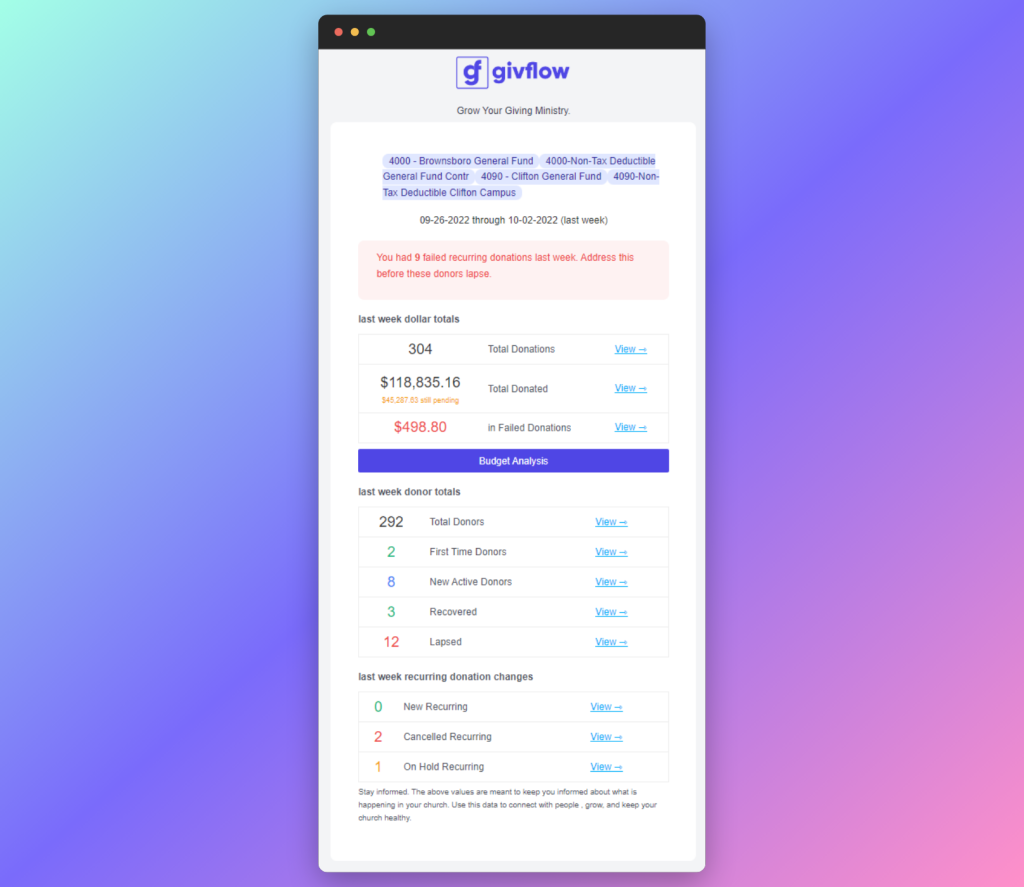
We shouldn’t have to list this one, but we have to. The reason being? Churches lose out on thousands of dollars every year because they don’t check in on failed donations. What’s a failed donation? A failed donation is gift a donor has attempted to give, but failed for a variety of reasons (e.g. card expired, insufficient funds, bank declined, etc…).
These are donors that are actively trying to give to your church, but for semantic reasons, they can’t. Here’s the thing, though, Planning Center will let them know their donation failed! This is great! Planning Center takes care of it for me! Well sort of. Assuming the email doesn’t get flagged as spam and they actually see it (50% chance optimistically), all of your donors are going to be like “what’s Planning Center?”, and then proceed to mark it as spam.
Make sure you or someone at your church is subscribed to receive budget notifications.
3. Lapsed Donors
Paying attention to lapsed donors is huge. At GivFlow, we consider our app a pastoral care tool as much as we consider it a financial tool. When a donor lapses, it gives you an opportunity to communicate with that donor. Your main goal is never to recover their donation (if that happens to be a bi-product of you’re communication, fantastic), but it is to remind them that they’ve called your church their home church in some capacity and you have resources available to them. We don’t ever want a donor leaving your church and telling their friends and family “I left, and no one noticed”. Stay on top of lapsed donors!
4. 80/20
Have you heard of the 80/20 rule? The 80/20 rule says 80% of your total budget will be given by 20% of your donors. Still not sure what this is? Well, this is basically attempting to you how much of your giving replies on less donors. In an absolute perfect world, everyone at your church is donating exactly the same thing – this would imply the top 20% are giving 20% of your total budget and therefor mean no single donor is weighted more than another donor. However, that’s not how giving works.
Any number over 80% just means your giving is skewed to reply on less donors – this isn’t a bad thing, just something to be aware of. If this number is higher, when budget planning it may be something you take into consideration.
5. Donor YoY Total Giving Comparison
If you’re looking at the budget analysis report (see 1), you might have a follow up question – what donors are giving more/less? The giving comparison report allows you to compare what donors gave over anytime frame (e.g. 2021, 2022, etc…) against a different time frame (e.g. 2022, 2023). This easily shows you which donors are giving more dollars, less dollars, or the same dollars.
This is helpful when digging deeper into the “why”.
Honorable Mentions
- Active non-recurring givers – recurring givers give more consistently and lapse less often. Knowing which donors are currently giving consistently, but don’t have a recurring gift set up is low hanging fruit in terms of increasing your church’s giving. Want to know why?
- Givers giving the same amounts over long periods of time – GivFlow aims to give you more data so you can communicate with your donors and grow your giving ministry. If you want to ever challenge donors that have come complacent in their giving, use this list to do that.
See what happens when giving is handled well.
A real walkthrough of how churches grow giving without adding work.
Book a Demo