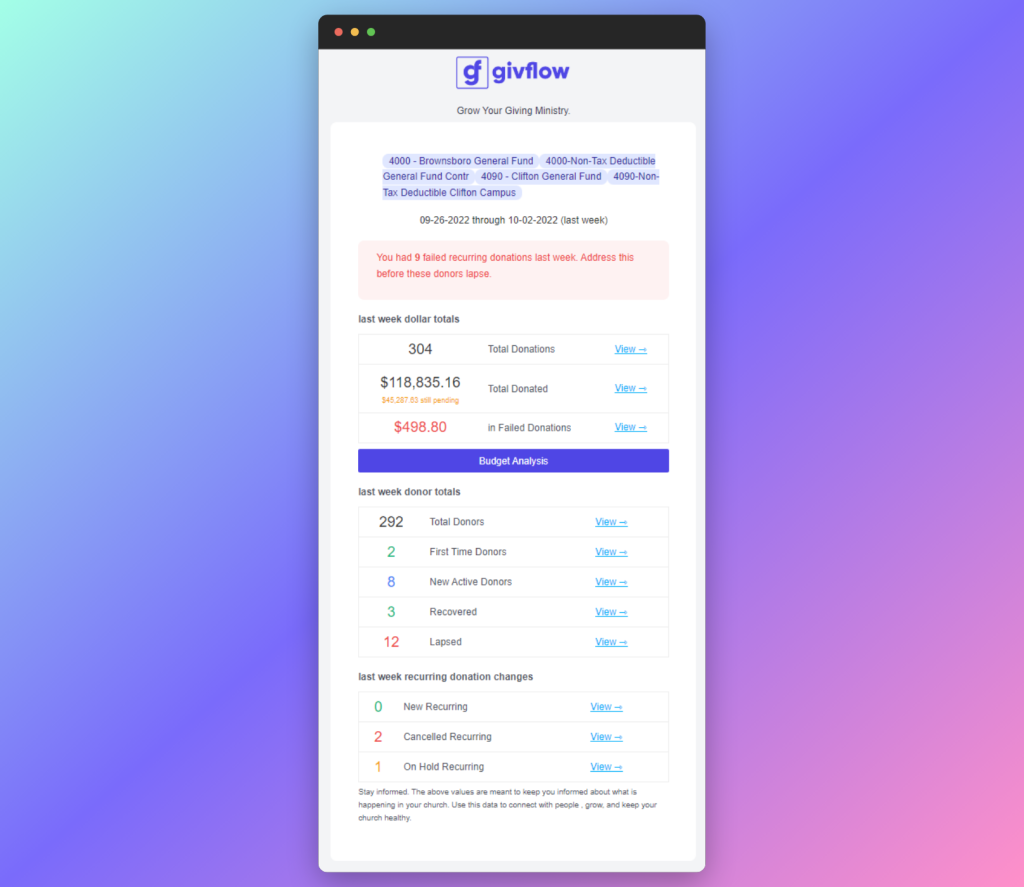
2 EASY ways to increase giving TODAY.
Not clickbait. These are 2 low hanging fruit opportunities to increase giving.
Look, we know that main goal of the church isn’t to increase giving – it’s to make disciples. However, we also know the church employs people to go and make disciples – people to put on and host events, people to pay bills to keep the lights on in a shared community space, and many more. This doesn’t have to be a taboo topic. Does more money mean more disciples? Absolutely not. However, we would argue it can help.
1. More Recurring Givers
At GivFlow, we house a lot of data. I mean a lot. That means we have access to insights you might not know. It is an UNDENIABLE fact that recurring givers lapse less often, and give more frequently throughout the year. Simple as that. If we look at your churches giving as a formula, we could potentially summarize it like this;
Contributions * Average Donation Amount = Total Giving
– Proprietary GivFlow formula
So in the simplest of terms, we know that increasing the number of contributions you receive, will increase total giving. Recurring givers give more contributions over the year. If you increase the number of recurring donations, your giving will go up.
2. Failed Donations
We shouldn’t have to list this one, but we have to. The reason being? Churches lose out on thousands of dollars every year because they don’t check in on failed donations. What’s a failed donation? A failed donation is gift a donor has attempted to give, but failed for a variety of reasons (e.g. card expired, insufficient funds, bank declined, etc…).
These are donors that are actively trying to give to your church, but for semantic reasons, they can’t. Here’s the thing, though, Planning Center will let them know their donation failed! This is great! Planning Center takes care of it for me! Well sort of. Assuming the email doesn’t get flagged as spam and they actually see it (50% chance optimistically), all of your donors are going to be like “what’s Planning Center?”, and then proceed to mark it as spam.
If you’re a Givflow subscriber, you know we already make a big deal about failed donations and notify you every week/month on failed gifts, but if you’re not, I encourage you to go in and check on the number of failed gifts at your church.
So what’s the solution? Email them from your church account (someone from the church in which they are familiar with). Let them know that their gift failed, and you would love to walk them through getting it set back up if they wanted. If you don’t here back, CALL THEM! I get it, you’re busy. However, what if ONE phone call recovered $100 gift. 15 minutes of your time (max), for that gift. Not to mention all the future gifts.
2a. Failed Recurring Gifts
In GivFlow, we make a HUGE deal about these. Why? Because every failed recurring gift is future lost income. Let me explain; If I have a recurring bi-monthly gift (e.g. 15th and 30th) for $100, and my recurring gift fails on the 15th, that’s $100 lost. Why? Because by the time I get around to fixing it, 9 times out of 10, I don’t go back and make up the gifts that I missed. So if I miss the 15th, the 30th, and then I miss the next 2 months before someone calls me, there’s a 90% chance you just missed out on $600.
What’s my point? MAKE FAILED DONATIONS A PRIORITY AT YOUR CHURCH!
See what happens when giving is handled well.
A real walkthrough of how churches grow giving without adding work.
Book a Demo